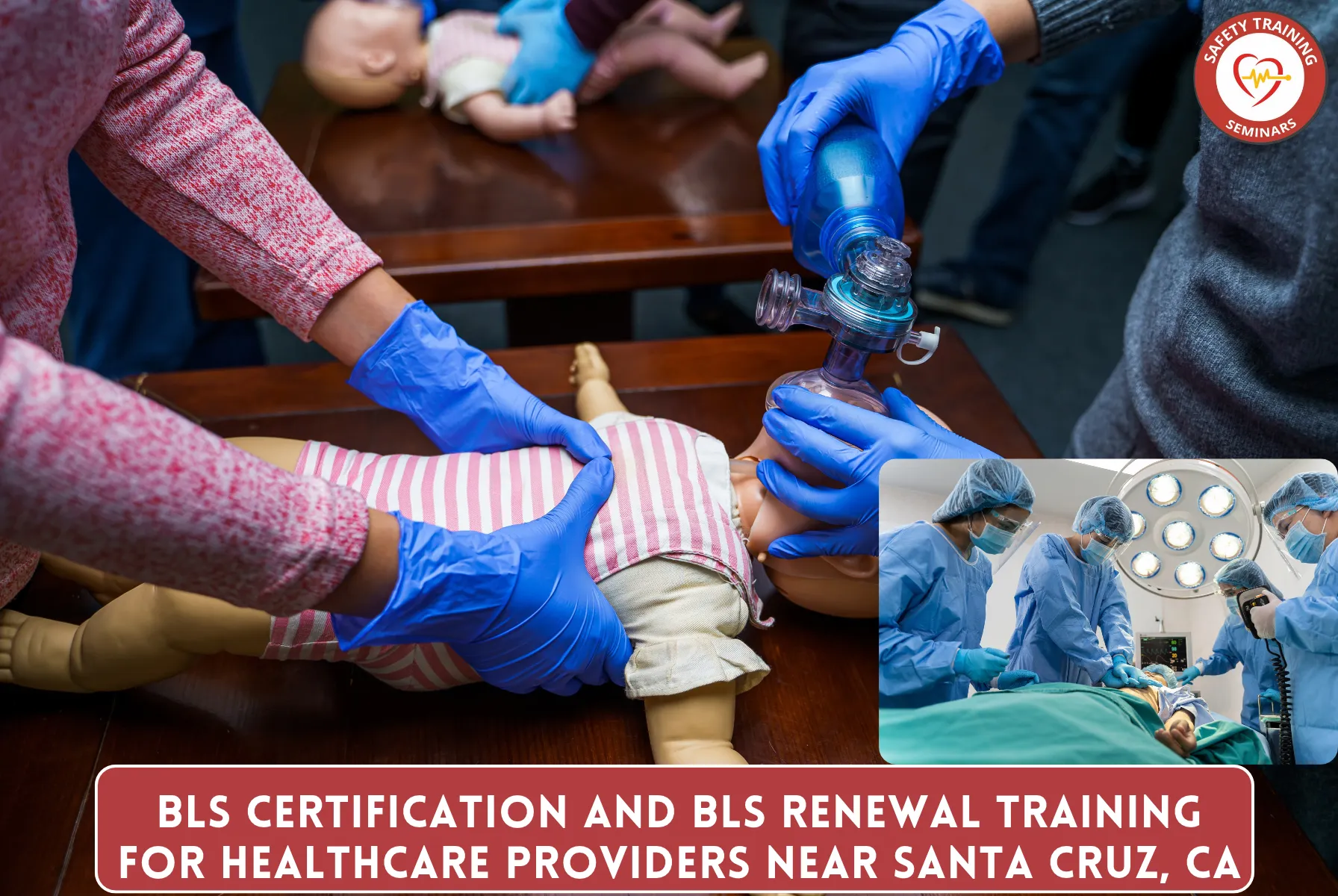
When cardiac or respiratory emergencies happen in any part of Santa Cruz County, from acute hospital wards and outpatient specialty clinics to dentist offices and community health centers, patient safety depends on doctors acting quickly and coordinating their care. Mastering Basic Life Support (BLS) makes sure that people who work directly with patients can act quickly and effectively in life-threatening situations, whether they are getting ready for a clinical training rotation or a BLS Certification Renewal.
Knowing what the American Heart Association (AHA) BLS Provider curriculum covers in terms of clinical practice helps nurses, doctors, medical assistants, and healthcare students choose the right training that fits their needs and their jobs.
The Role of Basic Life Support in Modern Clinical Settings
Professionals in health care and public safety provide basic life support, which is the first level of emergency resuscitation care. An AHA BLS course teaches doctors how to quickly spot cardiac arrest, respiratory arrest, and severe airway obstruction, and then use evidence-based treatments before advanced life support teams or emergency medical services take over.
In clinical settings, resuscitation works best when everyone on the team works together smoothly. CPR is not taught separately as a separate technical task. Instead, BLS education combines structured communication, shared clinical responsibilities, and individual psychomotor precision.
Essential Resuscitation Principles Taught in AHA BLS
An AHA BLS Provider course builds practical competence across core resuscitation skills for adult, child, and infant patients:
- Rapid Primary Assessment: Checking responsiveness, assessing breathing, and palpating for a central pulse simultaneously within established clinical timeframes to avoid delays in care.
- High-Quality Chest Compressions: Delivering compressions at the appropriate rate and depth for adult, pediatric, and infant anatomy while allowing complete chest recoil and minimizing interruptions.
- Effective Ventilation Delivery: Using pocket masks and bag-mask devices to provide adequate rescue breaths during single-rescuer and two-rescuer resuscitation without excessive ventilation.
- Automated External Defibrillator (AED) Operation: Powering on the AED, applying age-appropriate pads, clearing the patient safely during rhythm analysis and shock delivery, and immediately resuming chest compressions.
- Choking Recognition and Relief: Identifying mild versus severe foreign-body airway obstruction and applying age-specific interventions—such as abdominal thrusts, back slaps, and chest thrusts—for responsive and unresponsive patients.
- Multi-Rescuer Team Dynamics: Assigning explicit resuscitation roles, using closed-loop communication, and rotating compressor duties regularly to prevent rescuer fatigue and maintain compression quality.
Healthcare-Provider BLS vs. General-Public CPR Courses
Healthcare employers and clinical education programs distinguish sharply between healthcare-provider BLS training and general-public CPR courses. While community CPR courses equip lay bystanders to recognize an emergency, call for help, and begin basic compressions, clinical BLS training reflects the equipment, assessment responsibilities, and team workflows present in medical settings.
- Clinical Assessment Protocols: Healthcare providers check for a carotid, brachial, or femoral pulse alongside breathing assessment, whereas layperson CPR courses omit pulse checks.
- Airway Equipment Proficiency: BLS training incorporates bag-mask device ventilation and two-rescuer compression-to-ventilation ratios for pediatric and infant patients.
- Team-Based Resuscitation: Clinical environments require multiple staff members to coordinate compressions, airway management, and AED operation simultaneously.
Not every individual working inside a medical organization needs healthcare-provider BLS; non-clinical administrative personnel may follow separate workplace safety guidelines. Clinicians and students should confirm which specific AHA course their facility or academic program mandates before registering.
Healthcare Environments and Clinical Training Needs in Santa Cruz
Santa Cruz County supports a varied network of hospital, outpatient, and educational healthcare settings. Medical professionals working near Dominican Hospital in Santa Cruz, Sutter Maternity & Surgery Center of Santa Cruz, outpatient specialty clinics, urgent care facilities, and community health centers operate in clinical environments where immediate resuscitation readiness is vital.
Different care settings place distinct demands on clinical staff:
- Hospital and Surgical Care Teams: Nurses, physicians, respiratory therapists, and surgical technicians rely on standardized BLS protocols during acute inpatient emergencies and perioperative events.
- Outpatient Clinics and Urgent Care Centers: Medical assistants, nurse practitioners, and clinic nurses frequently serve as the first responders when a patient experiences acute cardiopulmonary distress in an ambulatory setting.
- Dental and Oral Healthcare Practices: Dentists, dental hygienists, and dental assistants maintain BLS Renewal for Healthcare Providers to prepare for medical emergencies involving local anesthesia, sedation, or medically complex patients.
- Allied Health and Nursing Education Programs: Students pursuing clinical careers—such as nursing and medical assisting programs at Cabrillo College in nearby Aptos—typically must verify current AHA BLS completion documentation before entering clinical placements.
Because hospitals, medical groups, and academic institutions establish their own compliance policies, learners should review their organization’s specific onboarding or renewal guidelines prior to enrolling.
Initial BLS Certification vs. BLS Renewal Pathways
Healthcare professionals searching for BLS Renewal Classes Near Santa Cruz or first-time courses generally choose between two training pathways depending on their clinical background and current documentation status.
| Comparison Factor | Initial BLS Provider Training | BLS Renewal Training |
| Target Learners | Healthcare students, new clinical hires, and professionals without current BLS completion documentation | Practicing healthcare professionals holding a current, unexpired AHA BLS Provider eCard |
| Curriculum Focus | Comprehensive introduction to resuscitation science, foundational CPR/AED skills, and clinical scenarios | Focused review of updated AHA guidelines, psychomotor skills refinement, and team resuscitation drills |
| Preparation Considerations | Ideal for learners building foundational clinical resuscitation habits from the ground up | Designed for clinicians who regularly apply or review clinical assessment and emergency protocols |
| Verification Step | Confirm required course name with your school or employer before registration | Check the expiration date on your current eCard and confirm employer renewal eligibility rules |
Navigating BLS Renewal Requirements
Maintaining current BLS documentation helps ensure uninterrupted clinical eligibility. Before selecting a renewal course, healthcare providers should verify the recommended renewal date printed on their existing AHA Course Completion eCard and confirm whether their employer requires an unexpired card to qualify for a renewal session. If a card has expired beyond an institution’s grace period, an employer may require completing an initial BLS course instead.
AHA BLS Course Structure and Completion Documentation
The American Heart Association’s BLS courses teach students how to think and do things while also testing their skills objectively and practically. Learners can finish the online cognitive part at their own pace before going to an in-person skills session, depending on the format they choose. For example, the HeartCode® Complete course lets learners do this.
Self-Guided LearningTM technology and a CPR Verification StationTM are used at Safety Training Seminars to help students practice and test their hands-on skills. Manikins with sensors measure the depth, rate, recoil, and volume of ventilation of the chest during this session. They give real-time feedback to ensure clinical accuracy.
Participants get an official AHA Course Completion eCard when they finish both the cognitive part and the hands-on skills evaluation. AHA Course Completion eCards show that you have successfully completed the resuscitation course for employers and training programs. They are not the same as a state professional license or regulatory credential.
Finding BLS Classes Near Santa Cruz, CA
Healthcare providers looking for BLS classes near Santa Cruz can access local training through Safety Training Seminars at its Santa Cruz training facility:
Safety Training Seminars — Santa Cruz CPR Training Center
1515 Capitola Road, Unit G, Santa Cruz, CA 95062
Located along Capitola Road, this training center serves nurses, physicians, dental professionals, EMTs, medical assistants, and healthcare students throughout Santa Cruz and surrounding coastal communities. The center offers AHA BLS Provider options for both initial learners and healthcare providers seeking renewal, as well as related clinical courses such as ACLS and PALS for professionals whose roles require advanced resuscitation training.
For current course options, format details, and upcoming session availability, clinicians can visit the BLS certification course near Santa Cruz page directly.
Frequently Asked Questions
Which healthcare professionals typically need an AHA BLS Provider course?
An AHA BLS Provider course is intended for medical professionals and students with patient-care or emergency-response duties. This includes registered nurses, licensed vocational nurses, physicians, physician assistants, nurse practitioners, dentists, dental hygienists, medical assistants, EMTs, paramedics, and nursing or allied health students.
How can I verify whether I am eligible for a BLS renewal class?
Check the recommended renewal date on your existing AHA BLS Provider Course Completion eCard and review your employer’s or school’s policy. Many healthcare facilities require an active, unexpired eCard to enroll in a BLS renewal option.
Do nursing and allied health students need BLS training before clinical rotations?
Most nursing, medical assisting, and clinical healthcare programs require students to present current AHA BLS Provider completion documentation prior to starting clinical rotations. Students should verify exact course specifications and submission deadlines with their academic department.
What is the difference between an AHA Course Completion eCard and a professional license?
An AHA Course Completion eCard serves as official proof that a learner has passed the cognitive and hands-on skills evaluations for an American Heart Association course. A professional license is granted by a state licensing board to authorize clinical practice within a specific healthcare profession.
Is BLS training relevant for outpatient clinics and dental offices?
Yes. Outpatient medical clinics, urgent care centers, and dental practices rely on the same AHA BLS resuscitation principles—including rapid cardiac arrest recognition, high-quality CPR, AED operation, and bag-mask ventilation—to stabilize patients during medical emergencies.
Plan Your Next BLS Training or Renewal Session
Maintaining a current level of Basic Life Support training helps to strengthen clinical readiness and supports compliance with standards that are in place in the healthcare workplace. By going to the Safety Training Seminars Santa Cruz BLS course page, you will be able to examine the many course formats that are offered, check the dates that are approaching, and register for the next session that will take place at the Capitola Road training center.